Shipping and Marine Gas Detection and Monitoring System
GAS DETECTION SOLUTIONS FOR SHIPPING AND MARINE
Seagoing vessels require gas monitoring for many reasons. Accommodation and general control areas onboard are monitored for explosive and toxic gases, these are usually safe areas and sensors and are mounted around the accommodation blocks and common areas such as the mess and control rooms. Air conditioning is something that is monitored to ensure that toxic and flammable gases aren’t present in the ducts, so H2S Hydrogen Sulfide and Hydrocarbon detection is used. Personal gas detection is also used when crew enter confined spaces, voids, pump rooms and are on deck to identify potential hazardous areas where there could be Oxygen depletion.
Our “Ex” equipment both fixed and portable will ensure the crew and personnel are kept safe and can promptly react to any potentially dangerous exposure limits whilst in Zone 1 areas. Our detectors can be connected to the vessel’s system to allow alarm indications and marshal sounder/beacons in the accommodation areas or on deck.
Hazardous areas may contain flammable liquids, solvents and toxic chemicals. All our systems can be connected to vessel system to allow continuous monitoring and allow historical logging. We as standard have multiple analog and digital outputs that can activate both visual and audible alarms i.e. beacons/sounders. We also have IECEX certification so you can be confident that we conform with all necessary legislation and regulations, so our sensors can be installed in Hazardous areas.
RECOMMENDED GAS DETECTION ELEMENTS:
CODE
NAME
DESCRIPTION
10100003
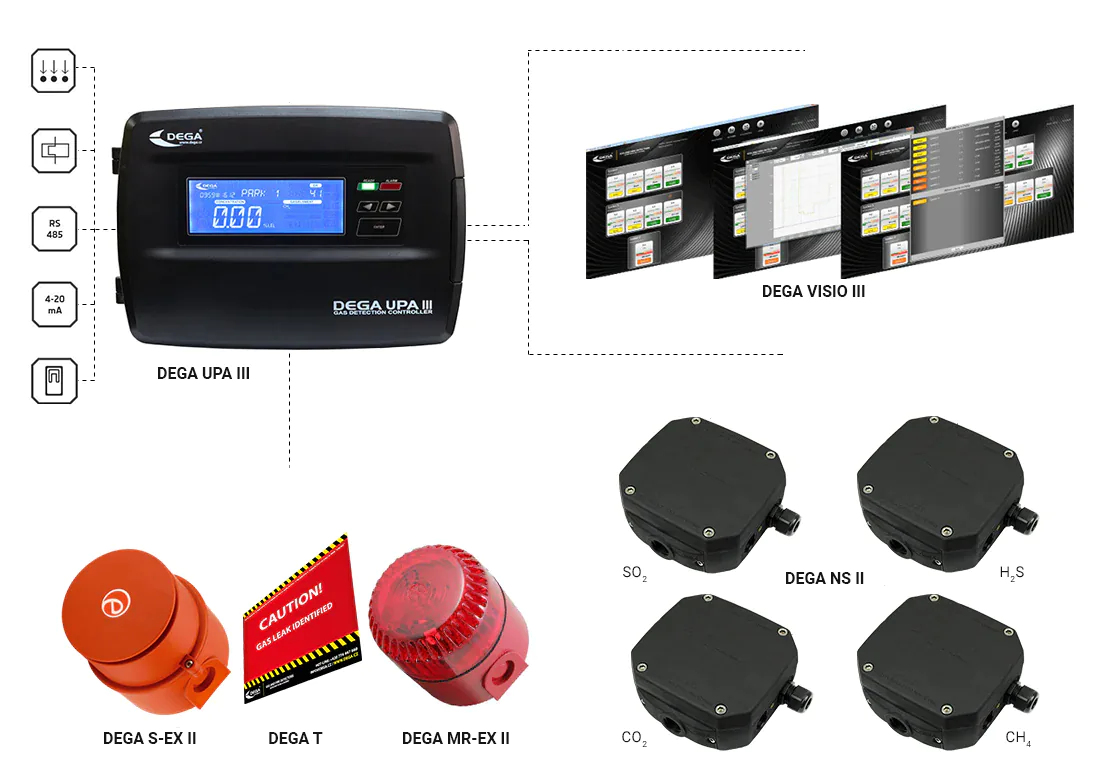
DEGA UPA III 16
Gas Detection Control Panel (max. 16 transmitters/detectors in 1 line (BUS). Input: 1 x RS485 x 16 pcs. Outputs: 3 x Relays and 2 x Output for Optical and Acoustic Signalisation, 1 x Output for External Button, 1 x USB. Power Supply: 24 VDC, HS: 85318070
10200019
DEGA UPA III Power
Internal Power Supply 230 VAC/15 VA
10200020
DEGA UPA III Relay Module
Internal Output, 7-relays, 250 V/10 A
10200021
DEGA UPA III RS485 Modbus RTU Module
Internal Output RS485 Modbus RTU
10200022
DEGA UPA III 4-20 mA Input Module
Internal Input 4-20 mA
10200023
DEGA UPA III Memory Module
Internal memory with battery
10300012
Cable Glands PG9 (10 pcs)
Cable Glands PG9 (10 pcs)
40100167
DEGA NSHC-IL 100 III LCD
Detector, EX ZONE 1, HC, 0-100% LEL, Infrared, 4-20mA, RS485 (DEGA), 24 VDC, HS:9027101000
Detector, EX ZONE 1, Hydrogen sulfide, 0-100 ppm, Electrochemical, 4-20mA, RS485 (DEGA), 24 VDC, HS:9027101000
40300008
DEGA WATER CAP - splash guard
DEGA WATER CAP - splash guard
50700001
DEGA MR-EX II
External optical signaling "Ex" ATEX (zone 1,2)
50700006
DEGA T
Information board with an inscription according to the customer's wishes. Text: "!WARNING! High concentration of dangerous gases"
50700001
DEGA S-EX II
External acoustic signaling "Ex" ATEX (zone 1,2)
HIGH ACCURACY IN BOTH FIXED AND PORTABLE DETECTORS
Our fixed and portable gas sensors are accurate to 0.1 % of the LEL / VOL scale, so you can be sure of reliability and timely indication of the gas presence reaching alarm limits. At which point you can relay the alarm condition via sounder / beacon, your internal system or most other audio / visual warning equipment